Deeper tissue reach
Longer near-infrared light generally scatters less as it moves through tissue. That makes this region attractive for deeper targets such as larger muscle groups, joint regions and transcranial applications.

1060 nm is the longest wavelength in the standard NrG Light spectrum and sits at the deeper-reaching end of the near-infrared range. It expands the panel beyond conventional NIR channels for deeper-tissue applications while also supporting research areas that include joints, bone-related outcomes, transcranial photobiomodulation and cognition.
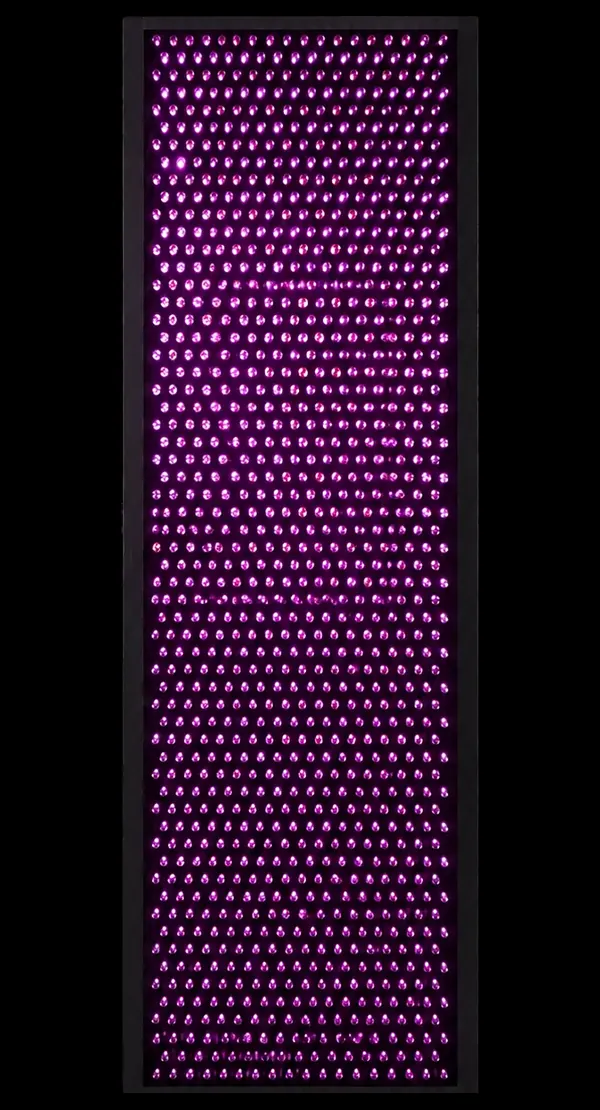
Near-infrared light penetrates more deeply than visible green, yellow and red light. At the long-wavelength end of NrG Light’s spectrum, 1060 nm is especially relevant when the target lies beneath the skin.
Longer near-infrared light generally scatters less as it moves through tissue. That makes this region attractive for deeper targets such as larger muscle groups, joint regions and transcranial applications.
Clinical PBM research in this near-infrared region has investigated knee and spine outcomes, pain and function, cartilage thickness, bone density and bone-repair measures.
Human transcranial PBM research in this region has examined learning and memory, attention, executive function, processing speed and global cognition.
Published research in this part of the NIR spectrum includes musculoskeletal, joint, bone-related and transcranial applications.
A systematic review of clinical PBM studies in this long near-infrared region included knee, spine, shoulder and elbow conditions as well as wound and osteoporosis research. Reported outcomes included pain, function, range of motion, cartilage thickness and bone-density measures.
A systematic review of human transcranial photobiomodulation evaluated learning and memory, attention, executive function, language and global cognition. The reviewed protocols used longer near-infrared light, and most studies reported improvement in at least one cognitive measure.
A placebo-controlled pilot in healthy adults over age 45 used transcranial near-infrared light. The study reported significant improvements in motor function, memory performance and processing speed, with no adverse effects reported.
A small pilot using near-infrared LEDs in people with dementia reported changes in executive function, immediate recall, visual attention and task switching, along with trends in EEG measures.
It is the longest wavelength in the standard NrG Light spectrum, extending the panel into a deeper-reaching part of the near-infrared range while preserving independent control over how strongly that channel is used.
Aura, Aurora and Phoenix use the full nine-channel NrG Light spectrum, and each channel can be independently adjusted from 0–100%.
Nine independently controlled wavelengths in a compact tabletop format.
View Aura →Nine-channel spectrum with broad coverage and flexible positioning.
View Aurora →Full-body coverage with nine independently controlled wavelength channels.
View Phoenix →Research findings describe specific study protocols and should not be treated as guaranteed outcomes from a different device, dose, distance or schedule.
1060 nm is the longest wavelength in the standard NrG Light spectrum. Longer near-infrared light generally scatters less than visible light, which is one reason this region is studied for deeper tissue and transcranial applications.
Research includes joint and spine outcomes, cartilage and bone-related measures, pain and function, as well as transcranial photobiomodulation and cognition.
NrG-AURA, NrG-AURORA and NrG-PHOENIX include an independently controlled 1060 nm channel.
No. 1060 nm is outside the visible spectrum, so the light itself is near-infrared rather than visible red light.