What it is
Photobiomodulation uses selected visible and near-infrared wavelengths at controlled doses to influence cellular activity. It is non-ionizing and contains no UV.
A practical guide to photobiomodulation—how wavelengths, dose, distance, safety, device formats and measurement methods shape a session.
Educational scope. This guide summarizes general PBM research. Results depend on the device, wavelength, dose, protocol and individual. Cited studies do not guarantee that any consumer device will reproduce the same outcome.
This guide summarizes general photobiomodulation concepts and published research. Studies may use exact, nearby or combined wavelengths delivered by LEDs, lasers, masks, panels or other hardware with different doses, schedules and treatment geometry. The information is not a device-specific performance claim for NrG Light or any other brand, and no consumer device should be assumed to reproduce a study result. NrG Light products are not intended to diagnose, treat, cure, mitigate or prevent disease.
These are the essentials. The full guide below explains the details, tradeoffs and supporting research.
Photobiomodulation uses selected visible and near-infrared wavelengths at controlled doses to influence cellular activity. It is non-ionizing and contains no UV.
Research supports benefits for some applications, but results depend on the wavelength, dose, schedule, target and device.
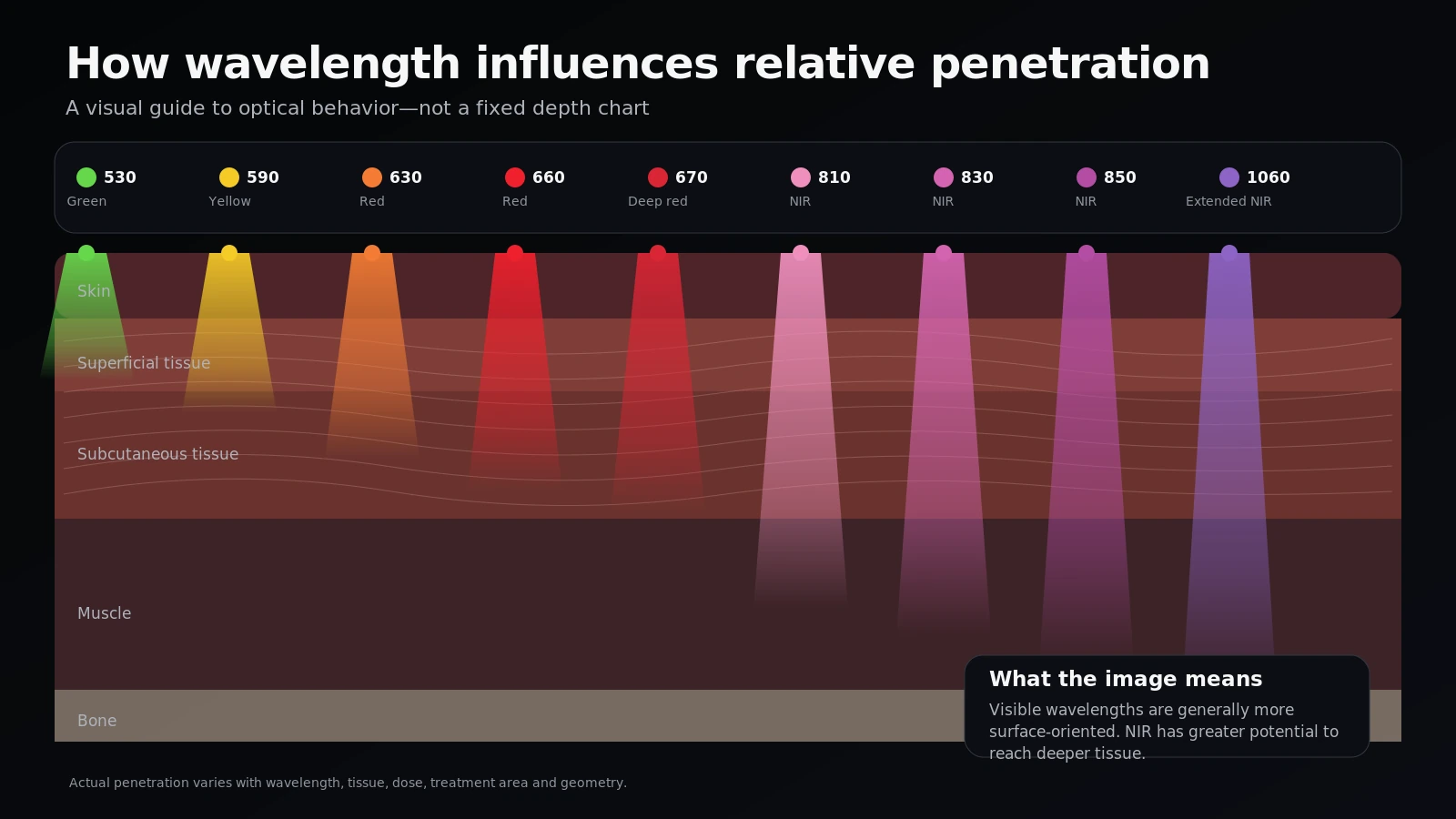
Green and yellow are more surface-oriented. Red is widely used for skin and recovery-focused sessions. Near-infrared has greater potential to reach deeper targets.
Irradiance describes how quickly light is delivered. Session time determines total energy. The goal is an appropriate dose—not maximum power for maximum time.
About 6–12 inches provides higher irradiance for targeted or recovery-focused use. Around 12–18 inches is a balanced middle range. About 18–24 inches provides broader, more even coverage.
Start conservatively and use a schedule you can maintain. Some changes may be noticed quickly, while others require repeated sessions over several weeks.
Do not stare into high-output LEDs. NrG Light offers green-tinted glasses and silicone light-blocking goggles. Get professional guidance when a medical condition or medication makes light exposure uncertain.
A smaller panel can deliver an appropriate local dose. A larger panel saves time by illuminating more of the body at once and reducing repositioning.
Nine independently adjustable wavelengths, high available irradiance, adjustable output, active cooling, measured output and multiple panel sizes give one platform broad flexibility from targeted to full-body use.
The fundamentals: what photobiomodulation is, how it works and how it differs from sunlight, heat and UV.
Red light therapy is the common name for photobiomodulation (PBM): the use of selected visible and near-infrared wavelengths at controlled doses.
PBM uses non-ionizing light and does not rely on ultraviolet exposure. A session is defined by its wavelength mix, irradiance, duration, working distance and treatment area.
Background: American Society for Laser Medicine & Surgery overview →
Longer than human beings have been on Earth.
Red and near-infrared wavelengths have always been part of sunlight. Modern PBM is much newer: it refers to isolating selected wavelengths and delivering them at controlled, repeatable doses, with research beginning in the 1960s.
Research supports benefits for some applications when the wavelength, dose and schedule are appropriate.
Human trials and reviews have reported measurable effects across several areas, but the strength and consistency of the evidence vary. The most useful question is not simply whether “red light works,” but whether the device and protocol match the intended use.
Research context: 2025 evidence-based PBM consensus → · 2025 umbrella review →
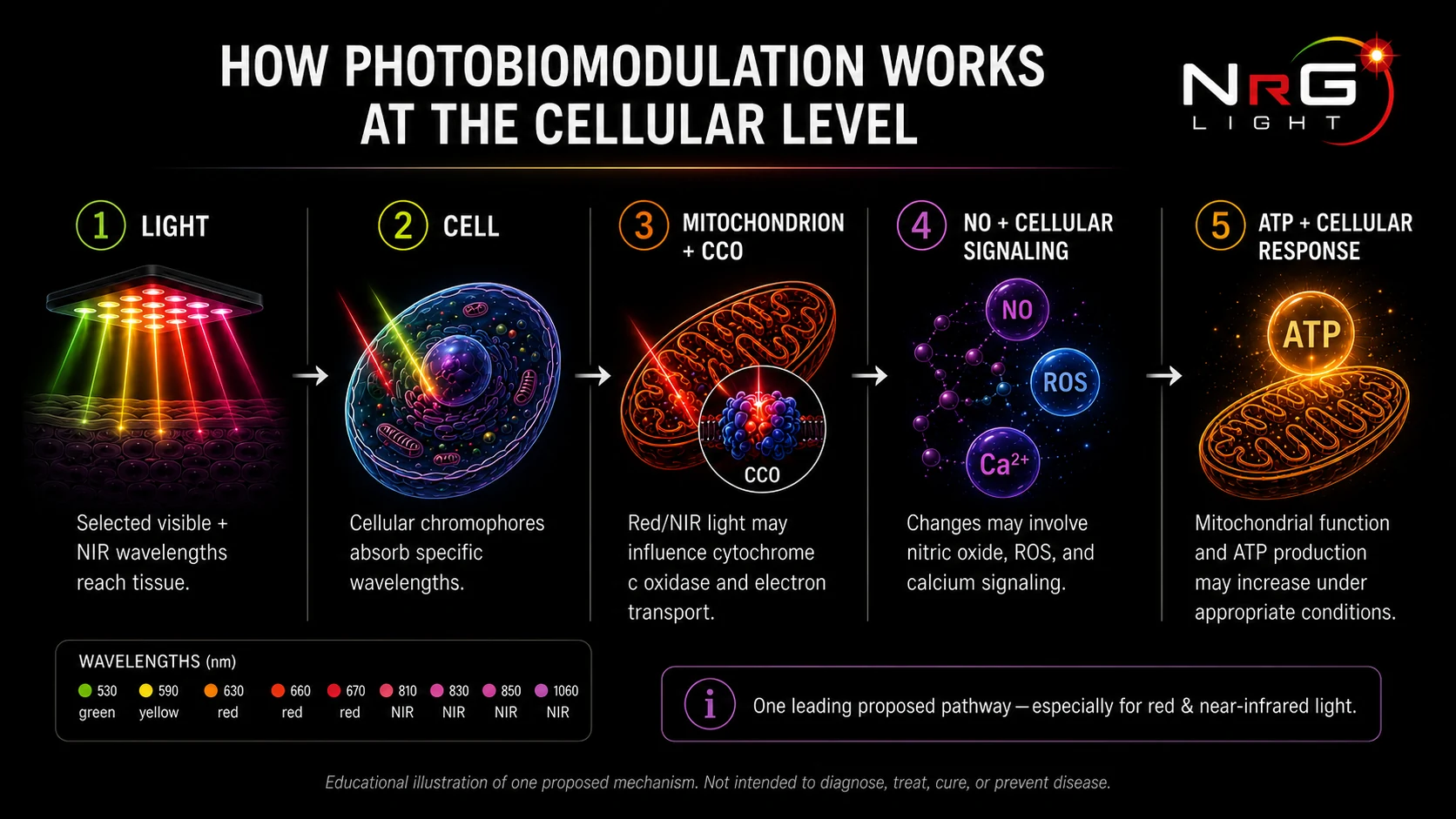
Certain molecules inside cells can absorb particular wavelengths of light. Red and near-infrared PBM is widely studied for its effects on mitochondrial activity and cellular signaling, with cytochrome-c oxidase among the proposed photoacceptors.
The biology involves more than one pathway, so the diagram below is a simplified overview rather than a complete map of every mechanism.
Mechanism context: 2024 PBM mechanism overview → · CCO and nitric-oxide evidence review →
Sunlight contains visible red, near-infrared and the rest of the visible spectrum, but it does not provide a controlled or repeatable PBM session.
Its spectrum and intensity change with the time of day, season, latitude, weather and atmosphere, and sunlight also includes ultraviolet radiation. A purpose-built device provides selected wavelengths, adjustable intensity, a known working distance and repeatable timing without UV.
Infrared saunas and heat lamps are designed primarily to warm the body. PBM is designed around selected optical wavelengths and dose.
A high-output panel may feel warm, but warmth is not the goal and is not a reliable measure of how effective a session may be.
No. Vitamin D production in the skin is primarily triggered by UVB radiation. Red and near-infrared light do not replace UVB for vitamin D synthesis.
A single, simplified guide to the nine NrG Light channels, their general roles and why independent control matters.
You do not need nine wavelengths for photobiomodulation to be useful. A one- or two-wavelength device can perform very well for a focused purpose.
NrG Light panels include 530, 590, 630, 660, 670, 810, 830, 850 and 1060 nm so one platform can support a broader range of skin-focused, recovery-focused and deeper-tissue sessions.
Independent control lets you emphasize visible wavelengths, emphasize near-infrared, reduce or turn off an individual channel, or use a preset when you want a simple broad-spectrum session. The advantage is flexibility—not the need to use every wavelength every time.
Select a channel for a basic overview of its role, common research areas and selected source links.
Green light adds a distinct skin, visual-comfort and cellular-research channel that is not covered by red and near-infrared light alone.
Compare the full 530–1060 nm spectrum or go deeper on four less-common wavelengths where NrG Light has a distinctive panel configuration.
Blue light is commonly studied for acne-related and antimicrobial applications. Green remains the standard NrG Light channel because it adds an uncommon visible-green wavelength and supports a different set of skin, cellular and visual-comfort research questions. Blue also requires more attention to dose, skin sensitivity and late-day use.
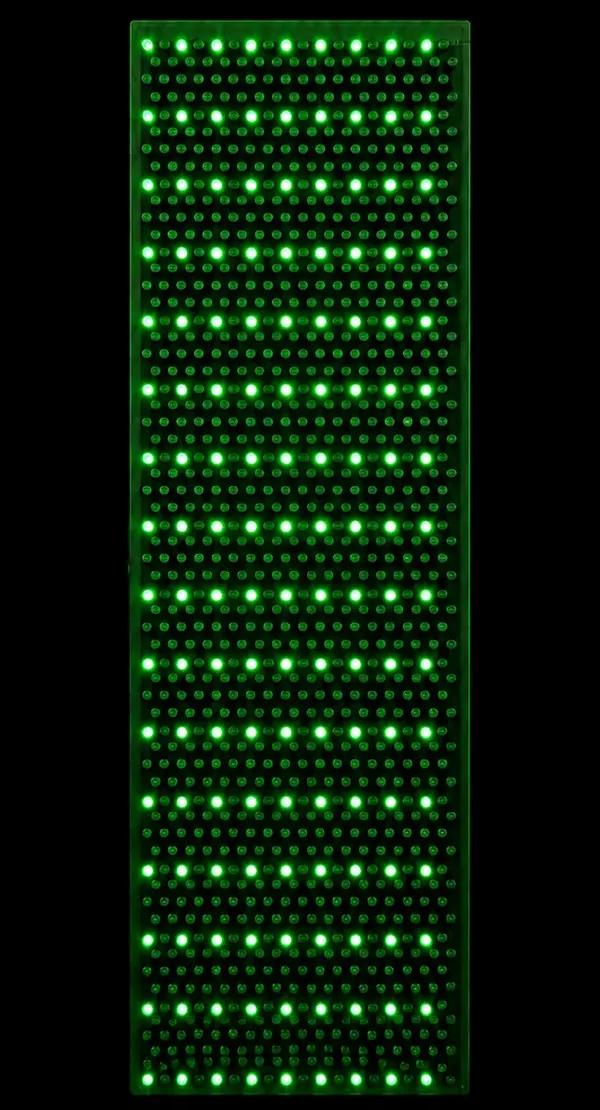
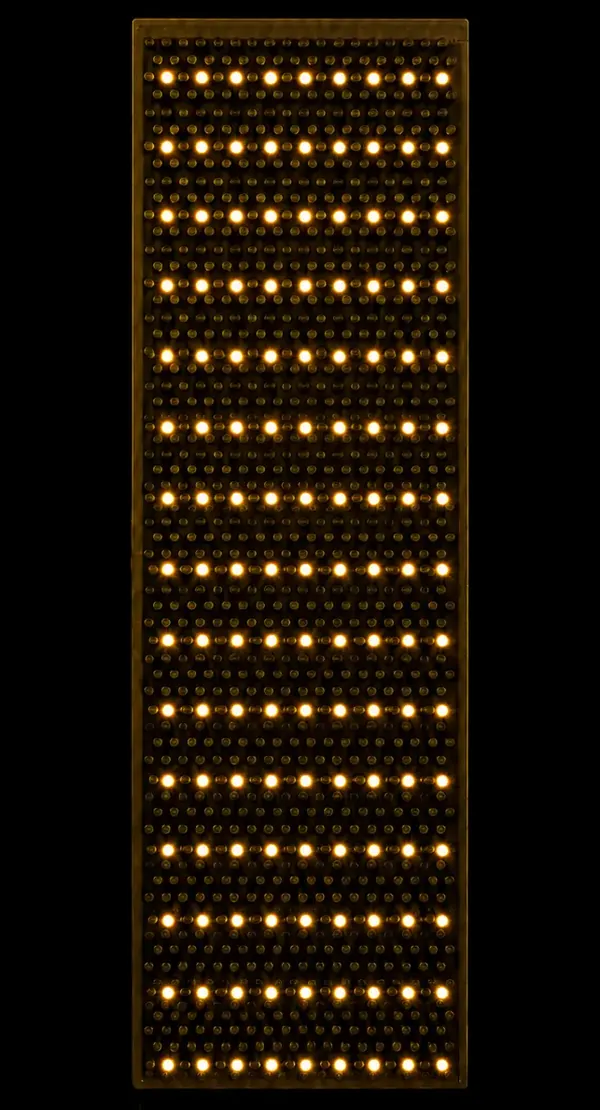
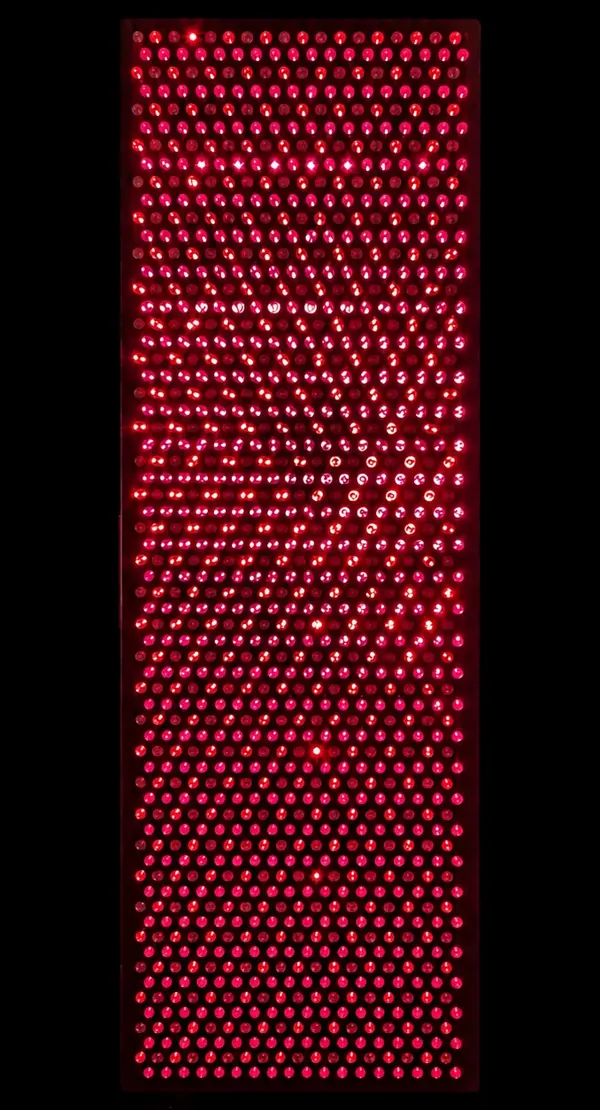
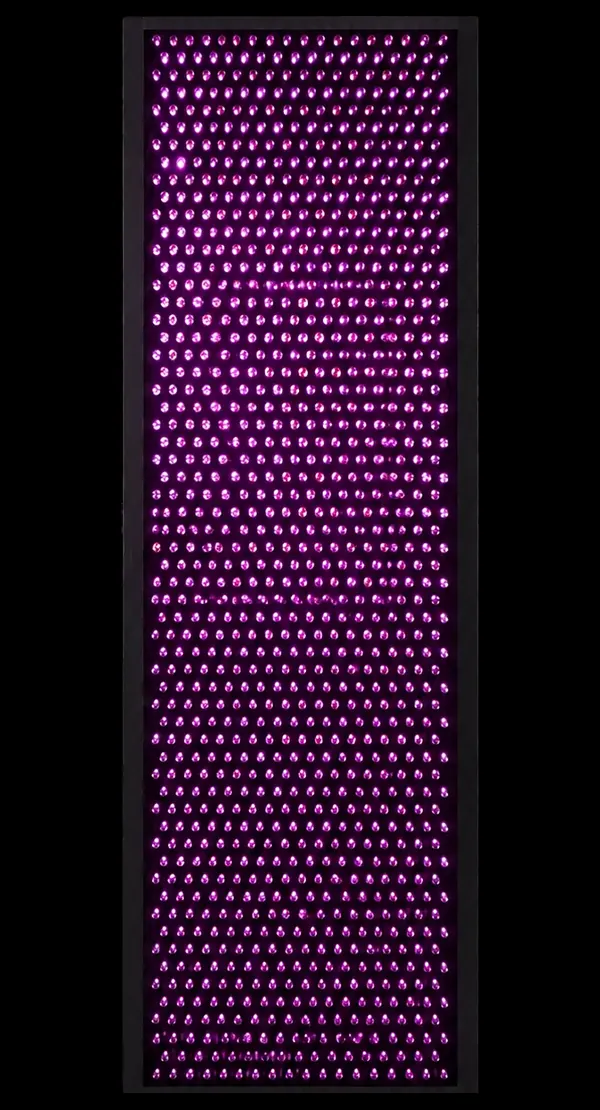
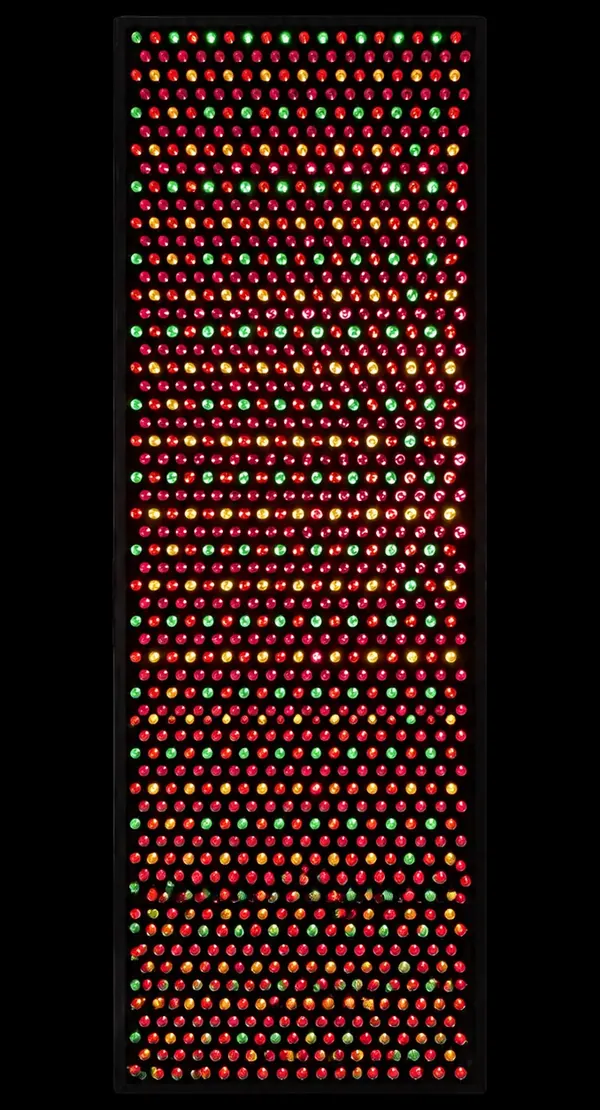
These product images show several wavelength modes available on NrG Light Aura, Aurora and Phoenix panels. Near-infrared is largely invisible to the eye, so photographs cannot represent its optical intensity the same way they represent visible colors.
A focused red/NIR device can work well. A broader independently controlled spectrum becomes useful when one system needs to support more session types.
Compare the panel sizes and see how independent wavelength control is implemented across the NrG Light lineup.
How intensity, time and working distance combine to shape a session.
Not necessarily. PBM is dose-dependent, and both intensity and time contribute to the total exposure.
The biphasic dose-response concept describes three broad zones: too little, an optimal range and more exposure than the target needs. A longer session therefore is not automatically a better session.
A high-output panel is most useful when that output can be adjusted. It gives you the range to shorten a session, increase working distance or reduce intensity rather than forcing one fixed level.
The same principle applies to wavelength settings. Using all nine wavelength channels at 100% may be appropriate for some broad-spectrum sessions, but it is not automatically ideal. The wavelength mix, intensity, distance and session time should match the intended use.
Research context: Biphasic dose-response review →
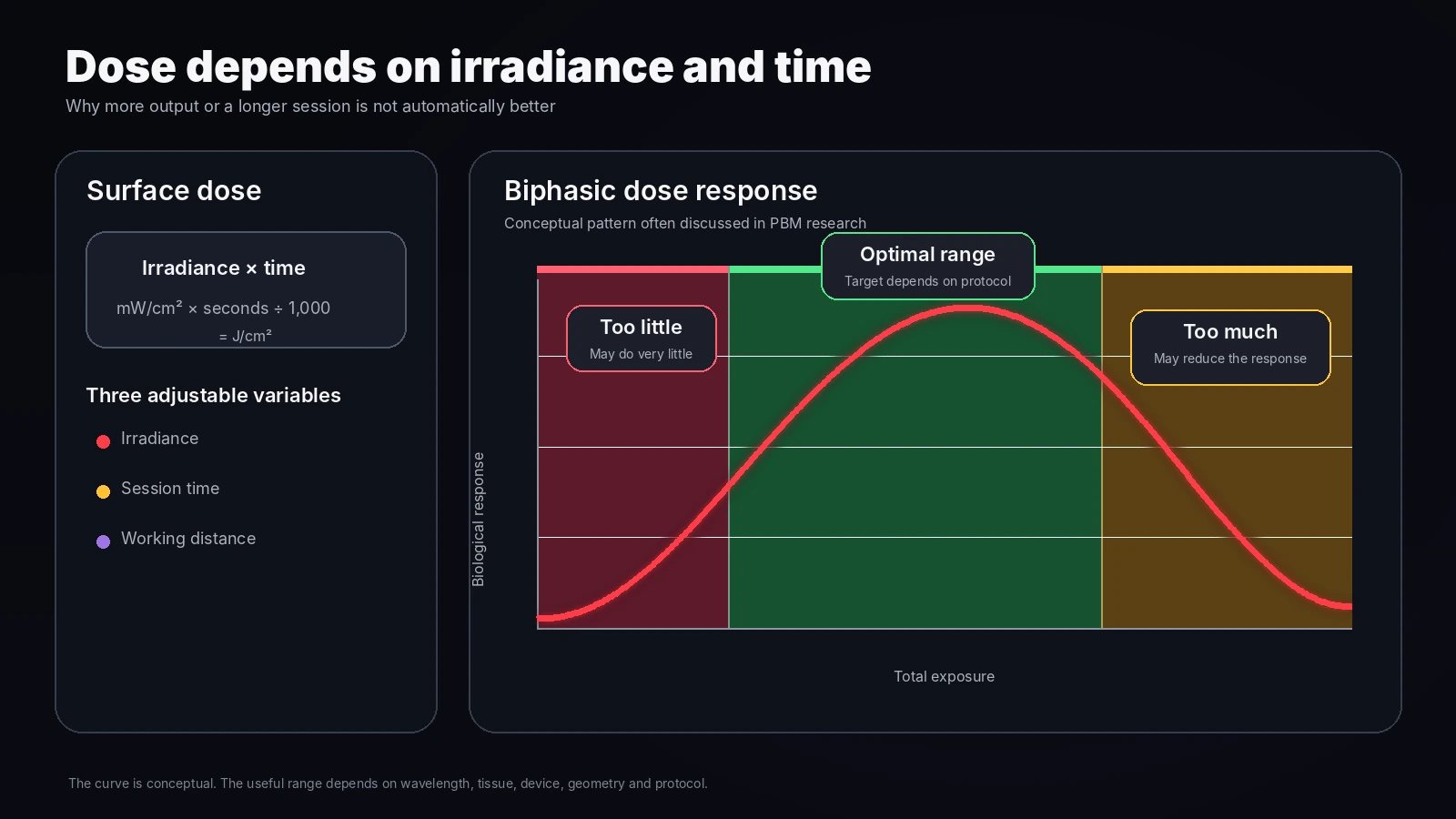
Irradiance is the amount of optical power reaching a given area, usually reported in milliwatts per square centimeter (mW/cm²).
It tells you how quickly light is being delivered at a specific distance. Irradiance helps estimate session dose, but it does not by itself describe field uniformity, the ideal exposure or how much light reaches deeper tissue.
A joule (J) is a unit of energy. Joules per square centimeter (J/cm²) describes the total light energy delivered to a given area. For continuous output, the approximate surface dose is:
The calculation is useful for comparing surface exposure. Wavelength, treatment area, beam geometry and tissue absorption still affect the biological context.
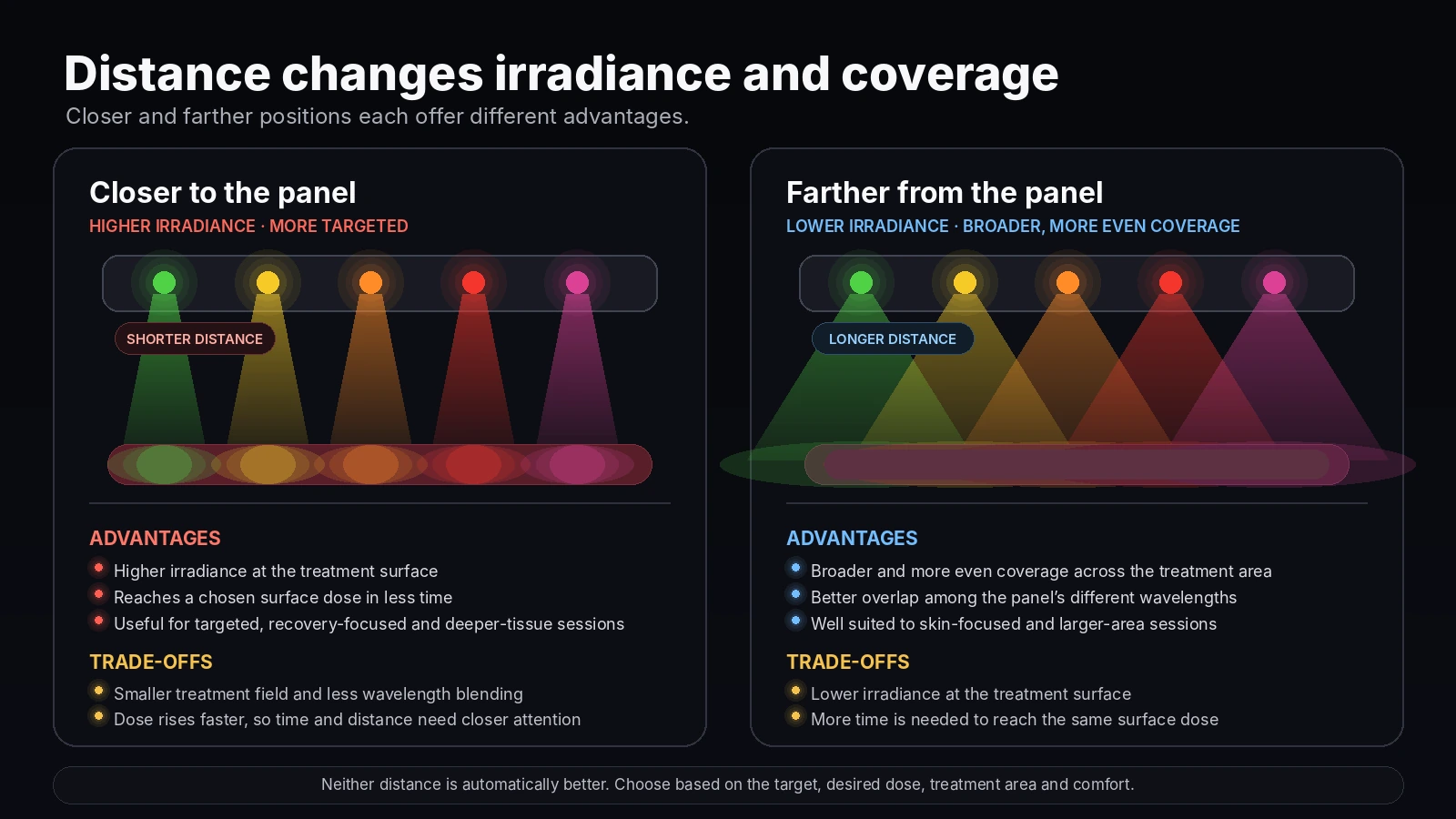
For most uses, a practical working range is about 6–24 inches from the panel. The best distance depends on the goal, the area being treated and how quickly you want to deliver the chosen surface dose.
Closer positioning — roughly 6–12 inches — usually produces higher irradiance at the treatment surface. That is often useful for recovery-focused, targeted, or deeper-tissue sessions, especially when you want to emphasize deeper tissues. The tradeoff is a smaller treatment field and less beam overlap between neighboring LEDs and wavelength channels.
Farther positioning — roughly 18–24 inches — lowers irradiance but gives the beams more room to overlap. This creates broader, more even coverage and a more uniform blend of the panel’s wavelengths, which is often especially useful for skin-focused and larger-area sessions.
The middle range — roughly 12–18 inches — is often a good general-purpose compromise when you want balanced coverage, comfortable positioning and moderate irradiance.
Neither distance is automatically better. If you move farther away, session time usually needs to increase. If you move closer, the treatment field becomes smaller and the session may need less time. Choose the working distance based on the target, desired dose, treatment area and comfort.
There is no universal schedule. Published protocols range from daily use to several sessions per week, depending on the goal, wavelength and dose.
Choose a schedule you can follow consistently and treat multiple same-day sessions as part of the same total exposure rather than as unrelated treatments.
An irradiance number only becomes meaningful when the measurement method is disclosed.
The reading can change with the instrument, spectral response, sensor size, distance, position and whether the sensor is placed at a center hot spot or across a representative treatment area.
For a fair comparison, look for the instrument, distance, wavelength range, field uniformity and whether the output can be adjusted.
NrG Light publishes wavelength-resolved readings from an OHSP-350IR spectrometer at stated distances. Broadband solar-meter readings are shown separately and labeled as a different measurement type.
For example, NrG-PHOENIX measured 82.5 mW/cm² at 6 inches by spectrometer. Publishing the instrument and distance lets the number be evaluated rather than taken out of context.
Instrument type and distance can change an irradiance reading substantially. NrG Light publishes both so the number can be evaluated in context.
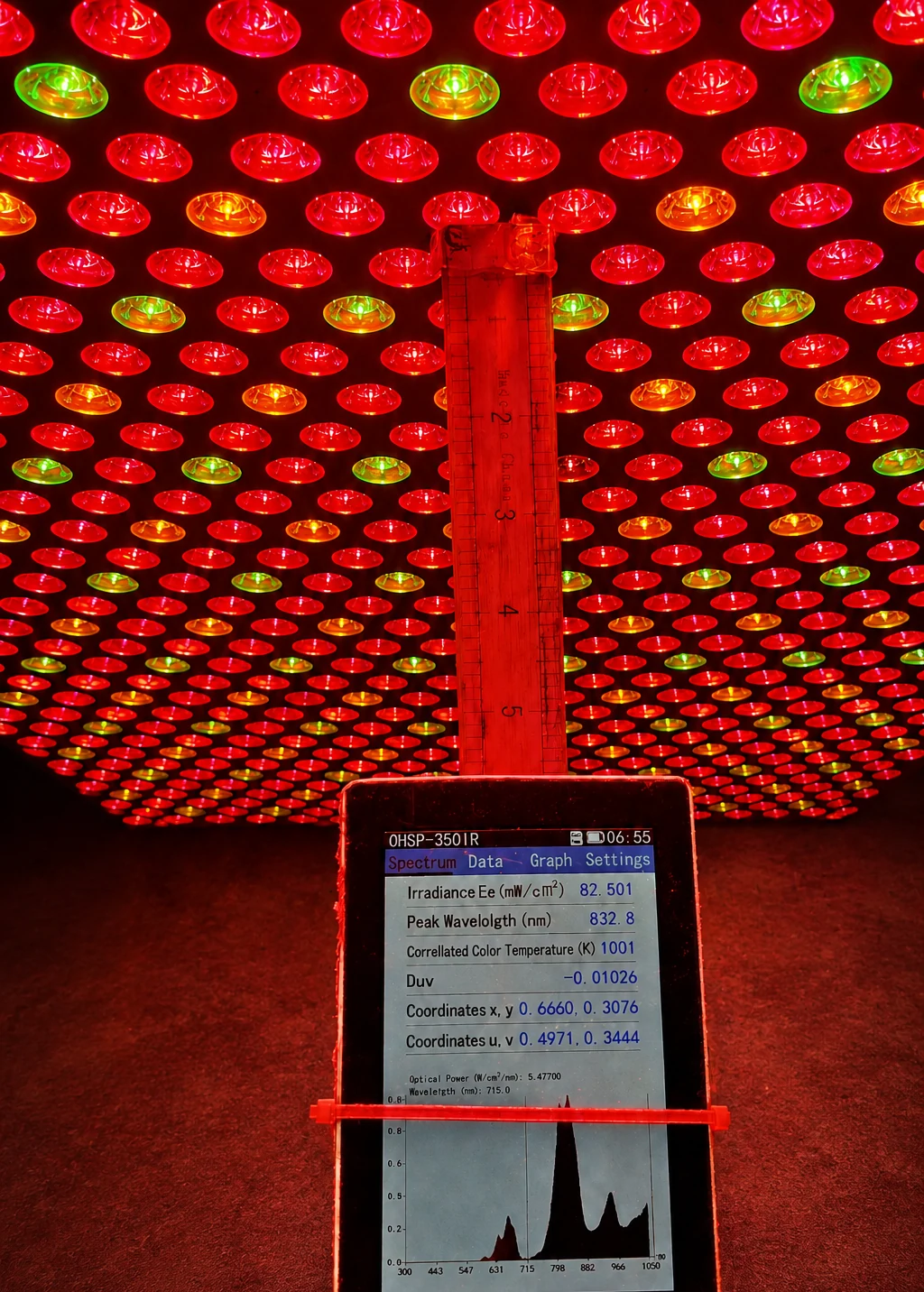
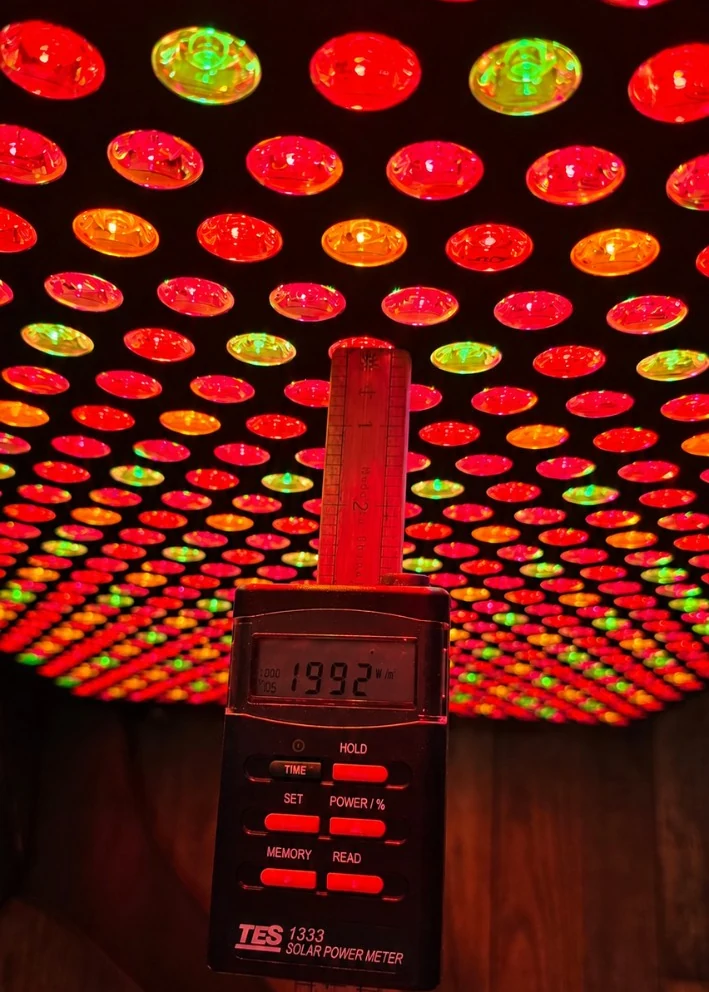
Irradiance readings change with the instrument, distance, sensor size and measurement position. A broadband reading taken close to one LED lens is not directly comparable with a wavelength-resolved reading taken across a working treatment field.
Solar meters are designed around sunlight and use a broad spectral response. Concentrated red and near-infrared output can therefore be weighted differently than it is by a spectrometer that resolves irradiance by wavelength.
NrG Light uses OHSP-350IR spectrometer measurements as the primary reference and publishes the working distance. TES-1333 solar-meter readings are shown separately as supplemental measurements.
Bare skin provides the most predictable exposure. Clothing can absorb, reflect and scatter light, and different fabrics behave differently.
Products differ in how they absorb and reflect light. Clean, uncovered skin provides the simplest and most repeatable setup unless you are intentionally following a protocol that includes a topical product.
Yes. Melanin, blood content and other tissue characteristics affect how wavelengths are absorbed at the surface.
PBM can be used across skin tones, but individual response can vary. Starting conservatively and using adjustable intensity makes it easier to find a comfortable, repeatable setup.
A complete system combines available output with transparent measurement and control over intensity, distance and session time.
Practical precautions, eye protection and situations where professional guidance makes sense.
PBM is generally considered low risk for most healthy adults when used as directed. Red and near-infrared light are non-ionizing and do not create a UV suntan or sunburn.
Possible short-term effects include warmth, temporary redness, skin discomfort, headache, eyestrain or afterimages from bright visible light. Sensible distance, session time, eye protection, electrical safety and thermal management all matter.
Research context: 2025 clinical PBM consensus →
No. Sunburn is caused by ultraviolet exposure, and NrG Light’s visible and near-infrared therapy wavelengths do not include UV.
Recommended intensity and session time still matter because excessive exposure can cause discomfort, unwanted heating or eye strain.
Do not stare directly into high-output LEDs or deliberately aim a general-purpose panel at your eyes.
NrG Light offers two eye-protection options:
Ordinary sunglasses may reduce brightness, but their tint alone does not show how much red or NIR they attenuate. Closed eyelids can improve comfort but are not the same as using the supplied or recommended eyewear when a high-output source is directed toward the face.
NIR is largely invisible, so visible brightness cannot indicate how much NIR is reaching the eye. Follow the device instructions and choose the NrG Light eye-protection option that best fits the session and your comfort preference.
Eye-specific PBM research uses purpose-built equipment and controlled protocols. People with significant eye disease or recent eye surgery should speak with an eye-care professional before directing high-output light toward the face.
Professional guidance is sensible if you:
The appropriate precautions depend on the person, wavelengths, device and intended protocol.
People with photosensitive epilepsy or a history of visually triggered seizures should not experiment with pulsed visible-light modes without medical guidance. Continuous mode avoids intentional flashing.
No. PBM may be used as a wellness tool or alongside a medically guided plan, but it is not a reason to delay diagnosis, stop prescribed treatment or replace necessary rehabilitation, medication or surgery.
A practical approach to first sessions, frequency, expectations and timing.
Start conservatively. Use a comfortable working distance, moderate intensity and a reasonable session length instead of beginning with every wavelength at maximum.
NrG Light’s adjustable output lets you begin with a simple preset and fine-tune the wavelength mix, intensity, distance and time as you become familiar with the panel.
There is no universal timeline. Some studies measure immediate physiological changes, while visible skin, hair, performance or rehabilitation outcomes may require repeated sessions over weeks or months.
Use a consistent routine and evaluate progress over an appropriate time frame rather than expecting one dramatic session.
You may notice brightness or gentle warmth, but PBM does not require a strong sensation.
A cool session can still deliver light, and additional heat does not indicate a better dose. Thermal sensation depends on wavelength, output, distance, room conditions and the device’s cooling system.
PBM has been studied both before and after exercise. The preferred timing depends on the goal and protocol; there is no universal window that is best for everyone.
There is no universal best time. Choose a time you can use consistently, and move the session earlier if bright visible light feels stimulating late at night.
How light attenuates through tissue and why near-infrared is studied for deeper targets.
Penetration is gradual rather than a fixed cutoff. Light is progressively absorbed and scattered as it moves through skin, fat, blood, muscle and other tissue.
Visible red is generally more surface-oriented, while NIR has greater potential to reach deeper muscle and joint regions. The amount reaching a deeper target depends on wavelength, tissue composition, treatment area, irradiance and geometry.
Some NIR can reach bone, especially where the bone lies close to the skin. The amount decreases as the thickness of overlying tissue increases.
PBM research has examined bone-regeneration processes, dental applications and fracture models. Human evidence for major orthopedic fracture healing remains limited, so fractures still require appropriate medical evaluation and care.
Yes, but only a fraction of the light reaches brain tissue. Transmission depends on wavelength, scalp and skull thickness, hair, location, source geometry and dose.
Research context: Human transcranial penetration study → · Transcranial penetration review →
Near-infrared brain research is exploring cognitive performance, mood, cerebral blood flow and other neurological applications.
Much of this work uses the near-infrared range represented by 810, 830, 850 and 1060 nm, often with purpose-built head devices positioned at specific scalp locations. Geometry and dose are therefore central to interpreting the results.
The field is promising but still developing, and there is no single standardized home-use protocol.
Research context: Human cognition study → · Near-infrared brain research review →
How panels, masks, caps and flexible devices differ in convenience, coverage, output and control.
For one local area, Aura can deliver the same wavelength options and an appropriate local dose. The main difference is how much of the body is covered at once.
Recreating a head-to-toe Phoenix session with Aura would require many separate placements for the face, torso, back, arms, hips, thighs, knees, lower legs and feet. It can be done, but the routine may take substantially more time and repositioning.
Phoenix illuminates far more tissue simultaneously, making broad or full-body sessions faster, more complete and easier to repeat. Its size does not automatically increase the dose at each square centimeter; the advantage is simultaneous coverage.
In an ideal setup, full-body coverage is the most complete and time-efficient approach. In the real world, budget and space matter—and a smaller panel you can use consistently is far better than a full-body panel you do not have.
Research context: 2025 whole-body PBM review → · PBM parameter review →
A targeted device can be an excellent choice when you only want to cover one area.
A panel becomes the stronger overall value when you want one system for the face, scalp, shoulders, back, torso, hips, legs, knees and feet. You can change the body area, distance and settings without buying a different device for each use.
NrG Light panels also combine high available irradiance with independent wavelength and intensity control. That range lets you reduce output for closer or more sensitive sessions, move farther away for broader coverage, and adapt the same hardware as your routine changes.
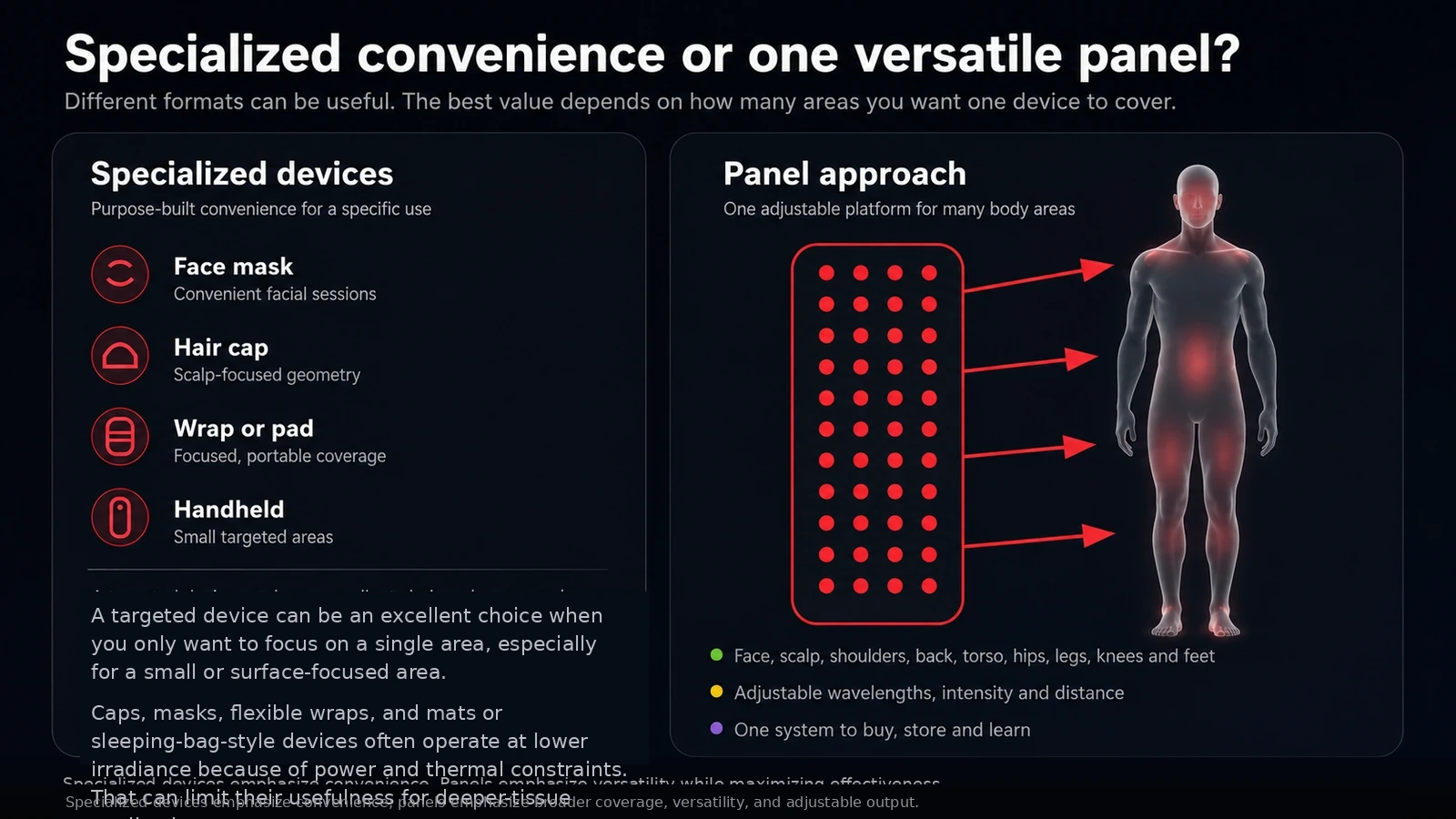
Well-designed masks can work, and their biggest advantage is convenience. Fixed positioning makes it easy to wear a mask while moving around the house.
Because the LEDs sit very close to the face, uniformity depends heavily on LED spacing, optics and diffusion. Some designs produce local peaks and valleys. A panel can be placed farther away so neighboring beams overlap across the face, neck and upper chest while intensity remains adjustable.
NrG Light plans to offer face masks in the future because the wearable format is popular and convenient. They will complement—not replace—the broader versatility and higher available output of a panel.
Certain red-light cap and helmet devices have credible human evidence for androgenetic alopecia. Their main advantages are convenience, close positioning and consistent geometry around the scalp.
A panel can illuminate the scalp, but hair, angle and distance affect delivery. A cap may be the easiest option when scalp use is the only goal; a panel offers better overall value when you also want to use the same device throughout the body.
NrG Light plans to offer hair-growth caps in the future because the wearable format is popular and convenient.
Flexible devices can be comfortable, portable and useful for a localized area, but the soft form factor creates power and cooling tradeoffs.
A rigid panel has room for larger power supplies, heat sinks, airflow paths and active cooling. NrG-PHOENIX uses 36 cooling fans to help sustain high available irradiance across a large area, while independent controls let the user reduce output when needed.
For these reasons, NrG Light is unlikely to focus on typical wraps, mats or sleeping-bag-style devices in the foreseeable future.
Choose targeted and portable, compact tabletop, broad mid-size, full-body or commercial coverage based on the areas you want to treat and the time you want to spend repositioning.
Find Your NrG Light SystemA focused device may be ideal for one area. A panel is designed to cover more body areas, distances and session types from one platform.
What each mode means, what research suggests and why continuous output is a sensible default.
Research has not shown that pulsing is universally better than continuous light. Continuous-wave PBM has produced benefits throughout the literature and is a sensible default for most users.
Some studies report different responses at specific pulse frequencies, but the findings are not consistent enough to identify one best frequency. NrG Light includes independently adjustable pulsing for users following a protocol that specifies it. Pulsing is optional, but including the feature helps future-proof the panel as research continues to examine whether specific frequencies or patterns offer additional benefits.
No.
NrG Light panels operate at 0% flicker in continuous mode. Intentional modulation occurs only when a pulse setting is selected.
A straightforward checklist for evaluating output, uniformity, coverage, cooling, controls and support.
Compare the complete system instead of choosing one headline number.
LED count and electrical wattage alone do not reveal useful optical output. Wavelength allocation, driver efficiency, optics, measurement method, thermal management and treatment area are most meaningful when considered together.
Wavelength choice, dose, uniformity, cooling, coverage, positioning and control are most useful when evaluated together.
Use the same wavelength, coverage, output, cooling and positioning criteria to compare every NrG Light format.
A short bridge from the educational principles above to how NrG Light applies them.
NrG Light panels bring together broad wavelength selection, independent control, adjustable output, active cooling and formats ranging from targeted to full-body coverage. The product-specific engineering, competitor comparison, measurement details and NrG Light Challenge live on the dedicated Why NrG Light? page so this guide can stay focused on PBM itself.
Representative sources used throughout the guide. Individual sections link to additional research where relevant.