Full-body efficiency
Treat far more tissue at once and minimize the repeated repositioning required with smaller panels.
Full-body coverage. Less repositioning. Complete control.
Phoenix is designed to illuminate the full front or back of the body at once, reduce the time spent moving a smaller panel between areas, and retain complete control over wavelength mix, intensity, pulse and session time.
Choose based on coverage, space, portability and how much repositioning fits your routine.
Treat far more tissue at once and minimize the repeated repositioning required with smaller panels.
Ideal when space allows a permanent full-body system with wall or stand positioning.
Standing, seated, targeted and horizontal use with the Phoenix Signature positioning package.
The photos below document the Phoenix output measured with an OHSP-350IR spectrometer and a broadband solar meter.
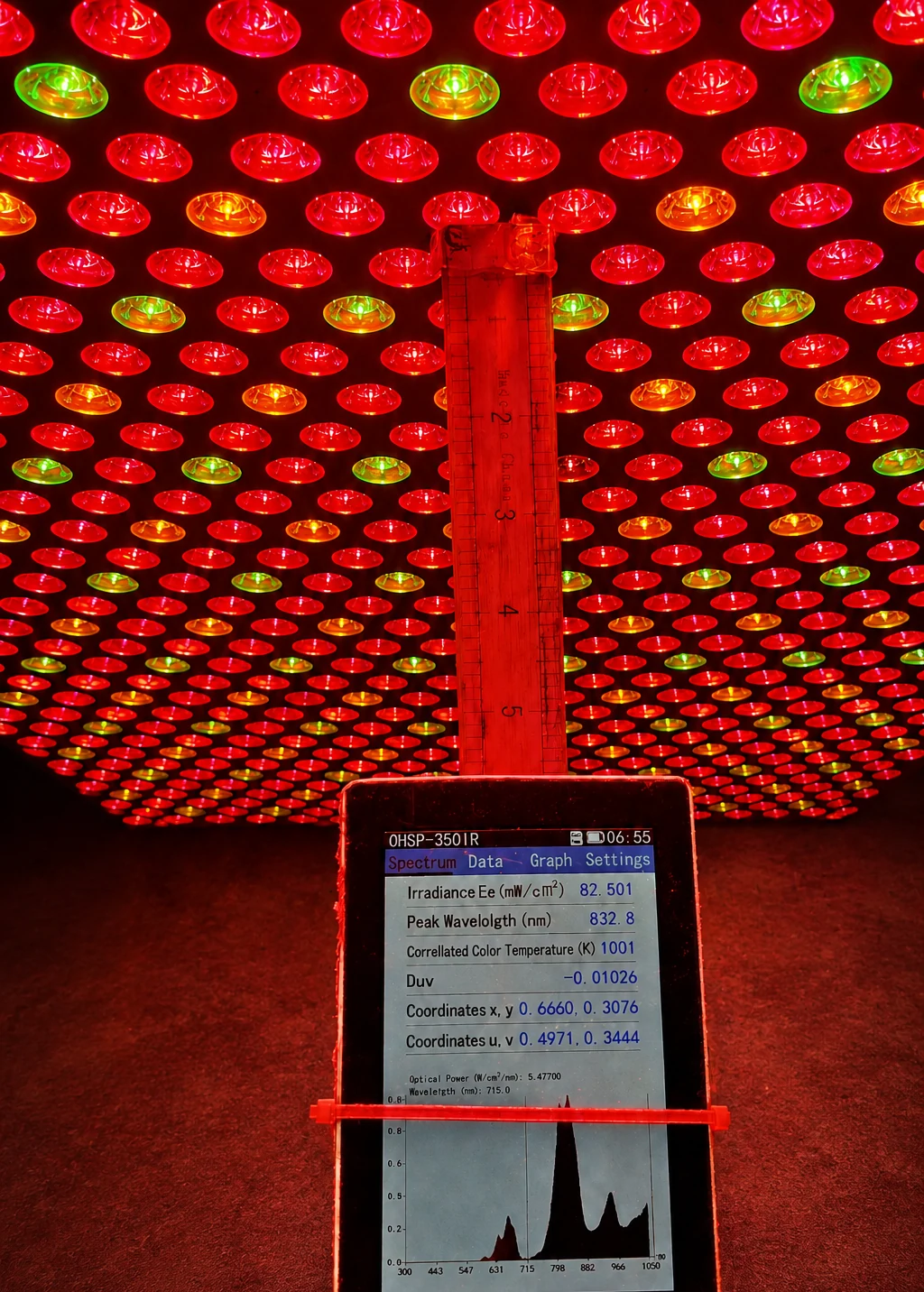
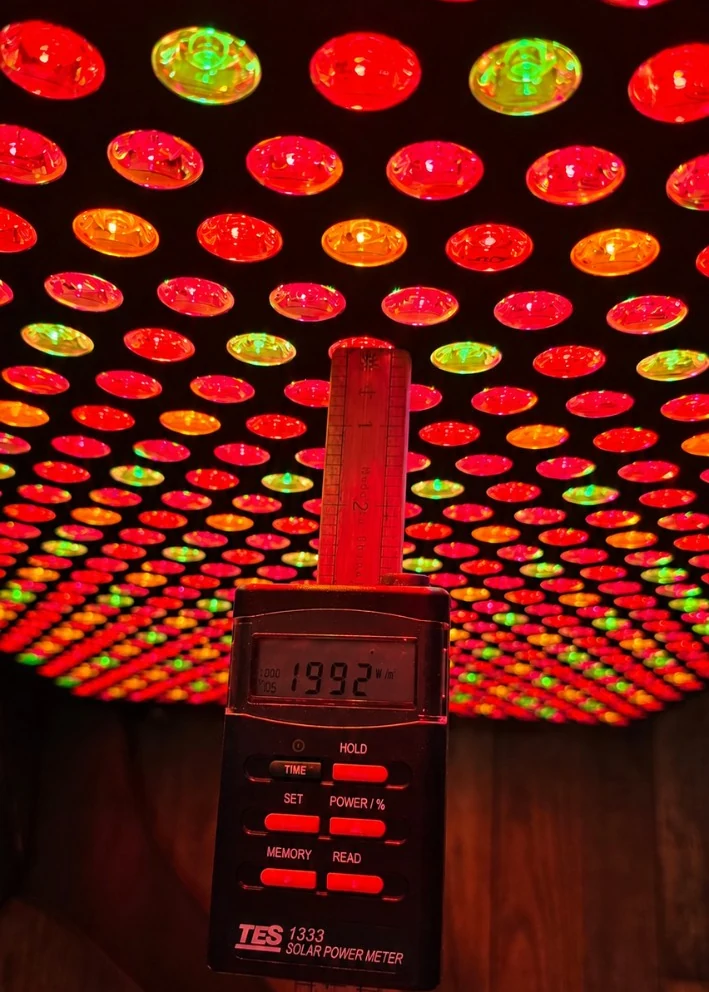
The solar-meter conversion uses the same factor: 1 W/m² equals 0.1 mW/cm². The spectrometer and broadband solar meter use different spectral responses and were photographed at different distances, so the 82.501 and 199.2 mW/cm² results are not interchangeable.
Explore all nine wavelengths and the research behind them →
Optional 480 nm blue is available by special request on preordered panels and replaces the standard 530 nm green channel.
The Phoenix Signature is the complete Phoenix + MS2000-B package. The standard Phoenix System keeps the panel wall-mounted.
Use the Phoenix panel dimensions and MS2000-B positioning range to plan the room footprint and orientation that fit your setup.
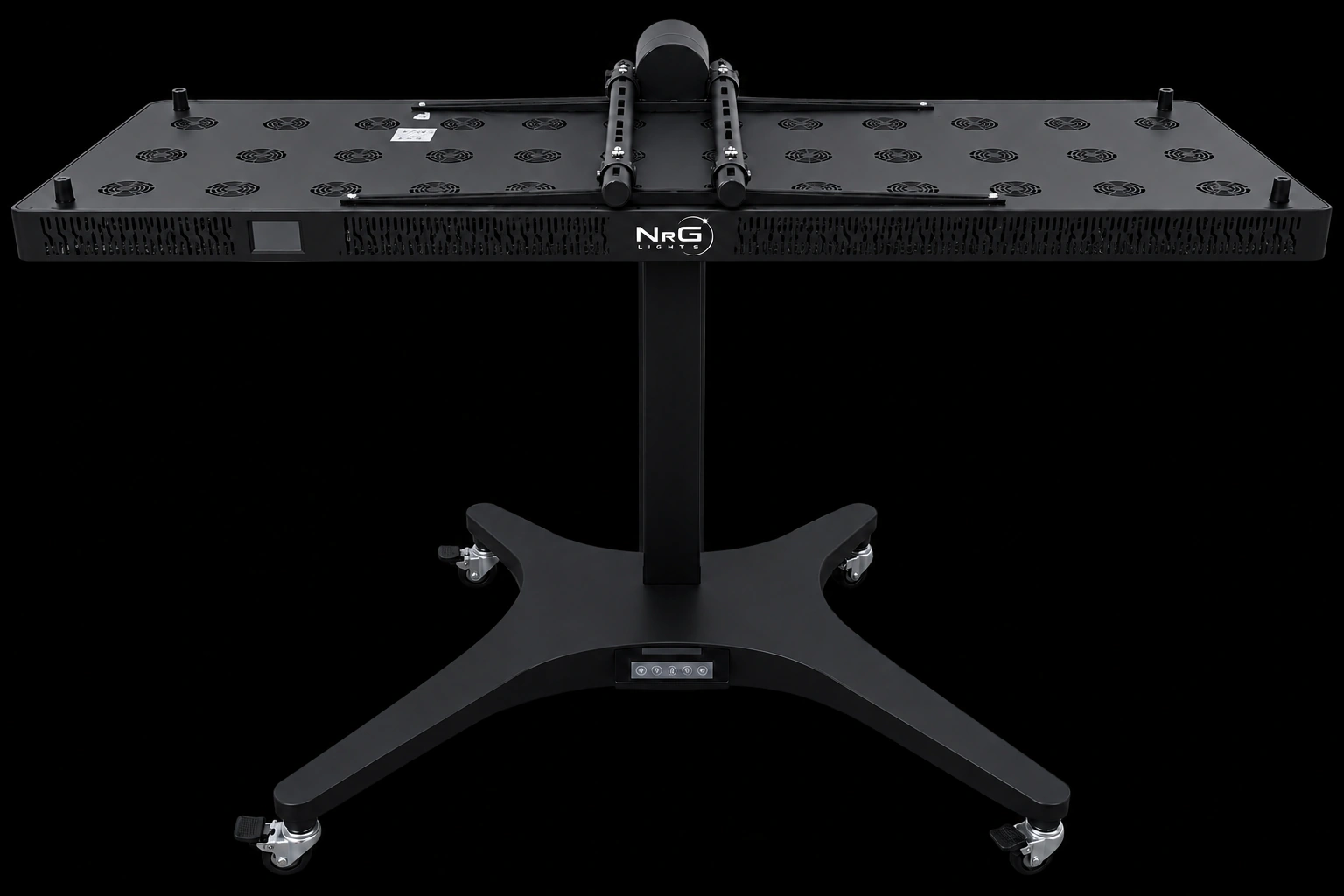
The MS2000-B stand combines remote-controlled motorized height adjustment with manual 360° panel rotation, giving Phoenix substantial positioning freedom. It is designed around the full-size Phoenix and is also compatible with Aurora, although its size is more than most Aurora installations require. The complete Phoenix Signature is $4,999. The Phoenix System is also available for $4,349 with a wall-mount bracket included.
Phoenix is designed as a large-format single panel rather than a multi-panel stack. Pair it with the MS2000-B stand for motorized height adjustment and manual 360° positioning, or use the included wall-mount bracket with the panel-only configuration.
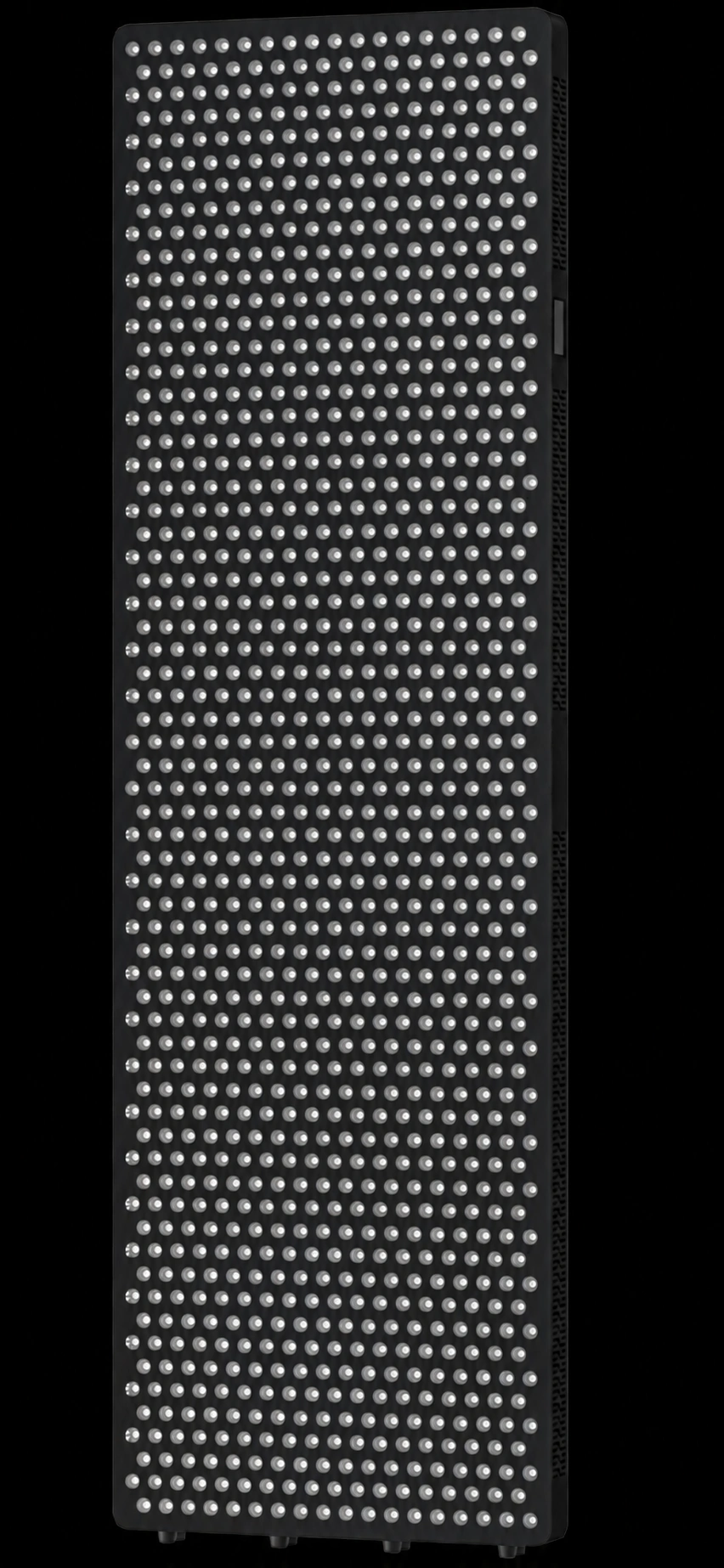
Phoenix keeps the user in an open space and makes positioning part of the system. Move the panel closer or farther, orient it around the body, and use independent wavelength controls to shape the session instead of placing every user inside the same fixed geometry.
No canopy closes over the head, making the experience feel less confined and leaving room air free to circulate.
Phoenix Signature raises and lowers by remote control. Panel rotation through 360° is manual, giving you flexible standing, seated, targeted, and horizontal positioning.
Keep the strongest field over the body while placing the face farther away—or use a gentler visible-light-forward mix with reduced NIR when preferred.
NrG Light’s full-panel platform is designed around direct wavelength control, brightness adjustment, pulse settings, session time, and one-touch scene presets.
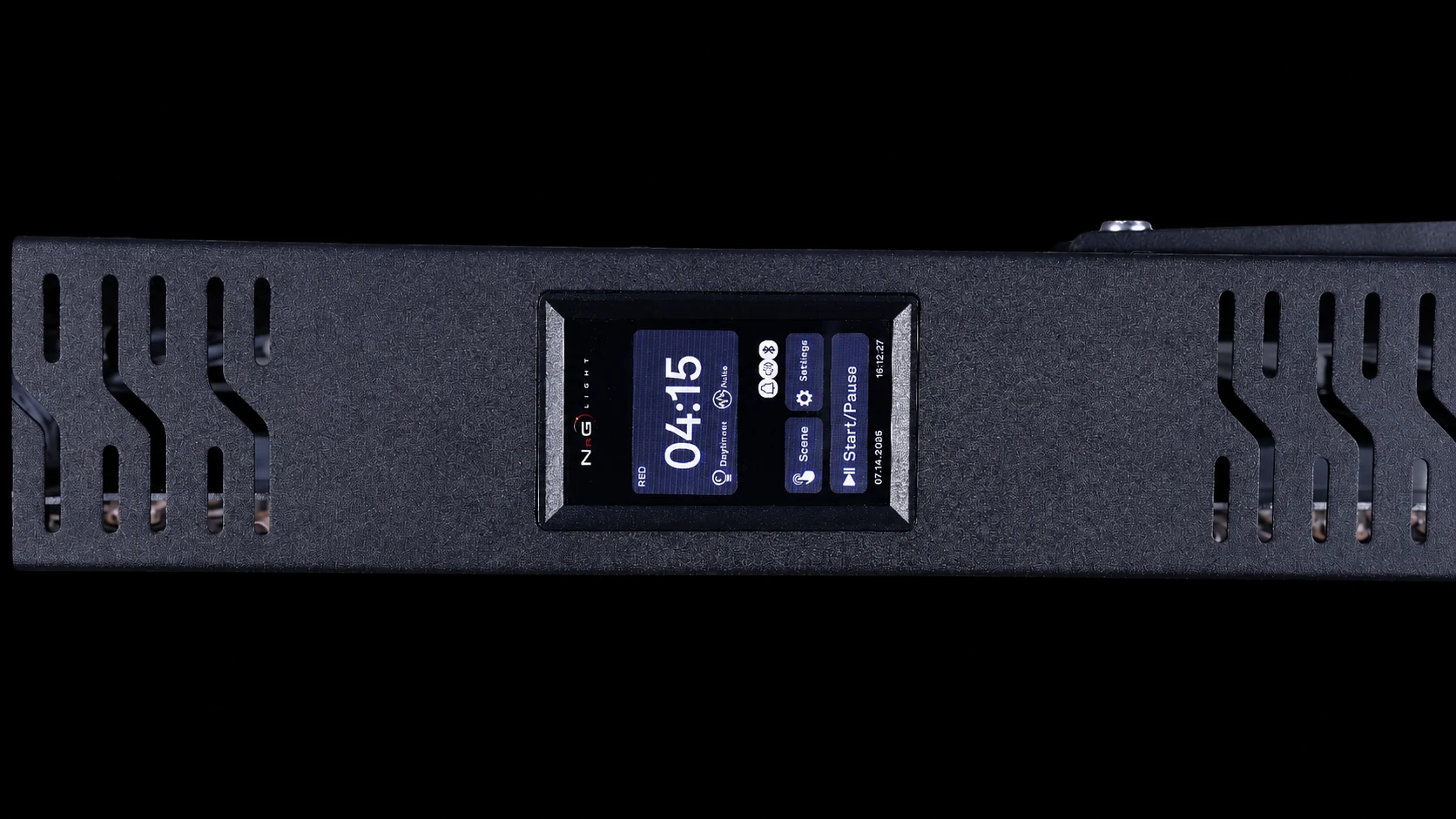
Adjust the nine wavelength channels independently from 0–100%.
Use one-touch scene presets as fast starting points when you do not want to configure every setting manually.
Set and monitor treatment duration directly from the panel.
Build a session around the available wavelength, intensity, timer, and pulse controls. Custom 1–4 user-programmed scenes are not available on all panels.
Android beta testing is underway now, with iPhone compatibility planned for a future release.
Shared panel controls + the 15-page illustrated MS2000-B motorized stand and Phoenix wall-mount guide.
Reviews from Phoenix customers, including customer photos and video links when submitted.