Mitochondria & cellular energy
Research at 670 nm has examined mitochondrial membrane potential, ATP-related activity and whole-body metabolic responses. These mechanisms are part of the broader reason red light is studied in photobiomodulation.

670 nm is a deep visible-red channel with a meaningful body of human photobiomodulation research. Studies have explored mitochondrial function, visual performance, metabolic response, exercise performance, muscle soreness and recovery.
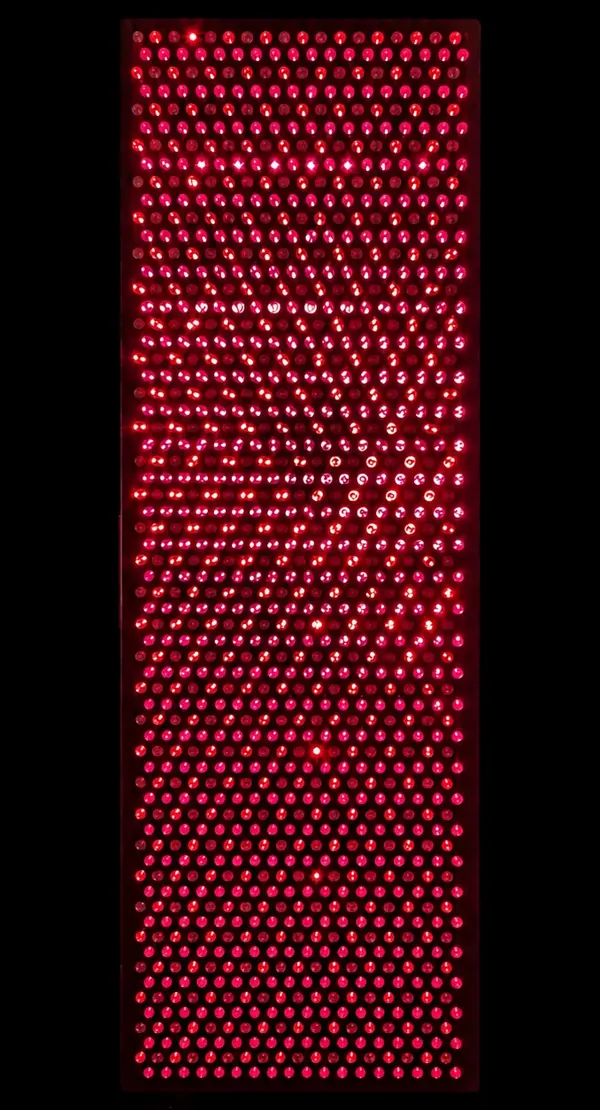
670 nm sits toward the longer end of visible red light and has been used directly in human mitochondrial, visual and metabolic research.
Research at 670 nm has examined mitochondrial membrane potential, ATP-related activity and whole-body metabolic responses. These mechanisms are part of the broader reason red light is studied in photobiomodulation.
Human studies have also explored 670 nm in visual-performance protocols and in mixed red/near-infrared exercise protocols measuring strength, delayed-onset muscle soreness and muscle-damage markers.
PBM wavelength basics →Unlike many niche wavelengths, 670 nm has multiple human studies using the exact wavelength as part of the experimental protocol.
A human study used 670 nm light in adults and reported improved color-contrast sensitivity in older participants. The researchers linked the work to age-related mitochondrial decline in photoreceptors and the influence of longer red light on mitochondrial performance.
A 2024 human experiment used 670 nm exposure before a glucose challenge and reported a smaller rise in blood glucose over the following two hours. The study was designed to investigate whether red-light stimulation of mitochondria could influence systemic metabolic response.
A randomized double-blind trial used a mixed red and near-infrared light cluster that included 670 nm LEDs. At selected doses, the protocol improved maximum voluntary contraction, reduced delayed-onset muscle soreness and lowered a biochemical marker associated with muscle damage.
It gives NrG panels a dedicated deep-red channel tied to exact human research in mitochondrial, visual and metabolic applications while also fitting naturally into performance and recovery-oriented red/NIR combinations.
Aura, Aurora and Phoenix use the full nine-channel NrG Light spectrum, and each channel can be independently adjusted from 0–100%.
Nine independently controlled wavelengths in a compact tabletop format.
View Aura →Nine-channel spectrum with broad coverage and flexible positioning.
View Aurora →Full-body coverage with nine independently controlled wavelength channels.
View Phoenix →Research findings describe specific study protocols and should not be treated as guaranteed outcomes from a different device, dose, distance or schedule.
Research areas include mitochondrial function, visual performance, metabolic response, exercise performance, muscle soreness and recovery.
NrG-AURA, NrG-AURORA and NrG-PHOENIX include an independently controlled 670 nm channel.
A dedicated 670 nm channel broadens the panel’s red-light range and allows protocols that specifically emphasize deep-red light without giving up the other visible and near-infrared channels.
Yes. Aura, Aurora and Phoenix allow the 670 nm channel to be adjusted independently from the other wavelength channels.